
Session Mode
このコンテンツはまだ日本語訳がありません。
Session Mode records what you play: your songs, your scores, your new personal bests, and with a heart-rate monitor, how hard it was. This page covers what it tracks, how to connect a monitor, and what to do when one won’t connect.
What is Session Mode?
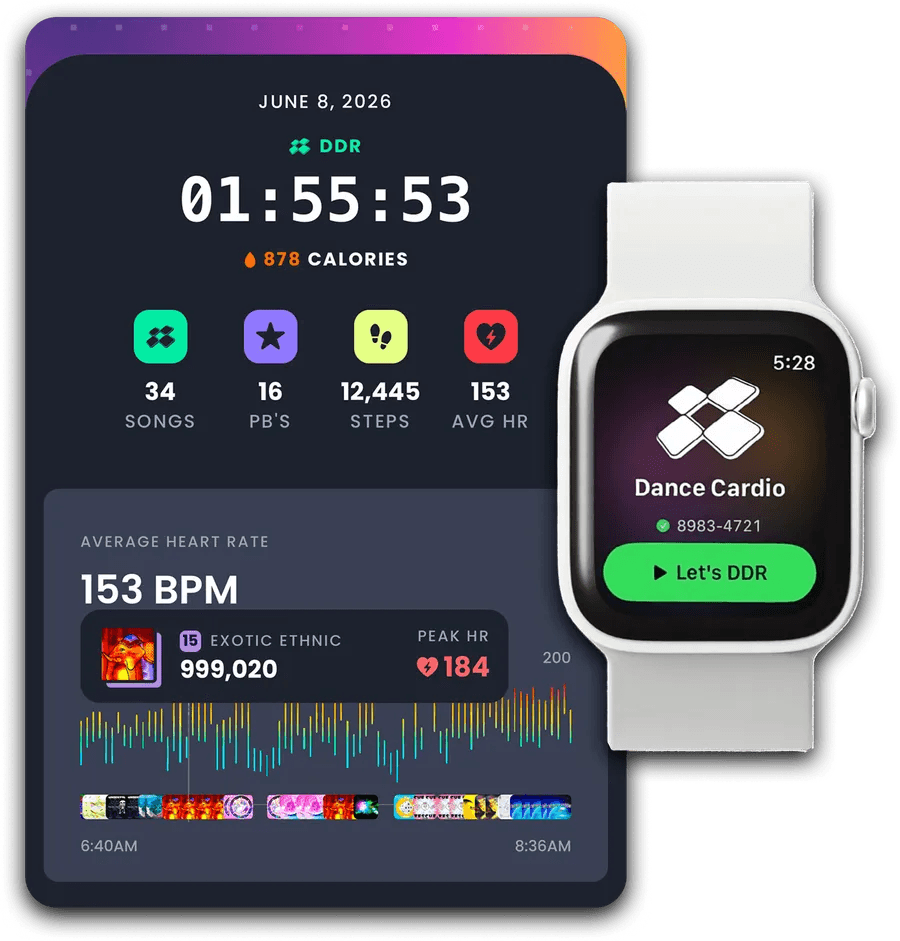
Section titled “What is Session Mode?”Session mode is a powerful way to get advanced training data to help you analyze and improve your gameplay. Start an Upscore session when you’re about to start gaming! When you start a session, Upscore creates a timestamp. When you end your session, your scores are automatically pulled so you can see what you played, new personal bests, consistency data and advanced analytics specific everything you played during your session.
Do I need a heart rate monitor to use Upscore?
Section titled “Do I need a heart rate monitor to use Upscore?”Nope. You can use Upscore’s session mode without a heart rate monitor. Upscore records your session, your songs, your scores and your personal bests even without a heart rate monitor. A monitor adds live BPM, heart-rate zones, calorie estimates and the per-song heart-rate chart in your session recap. It’s the difference between “here’s what you played” and “here’s how hard it was.”
What does Upscore actually track during a session?
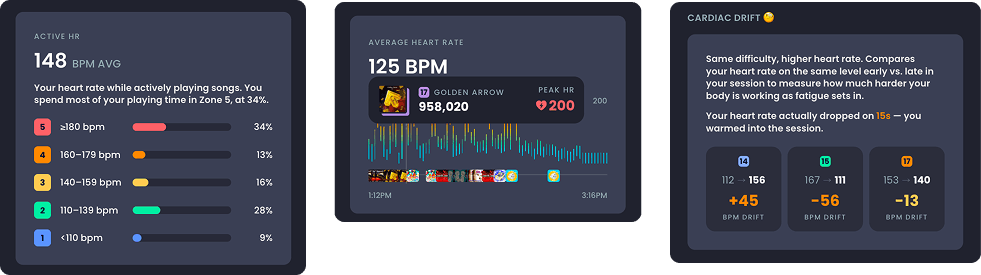
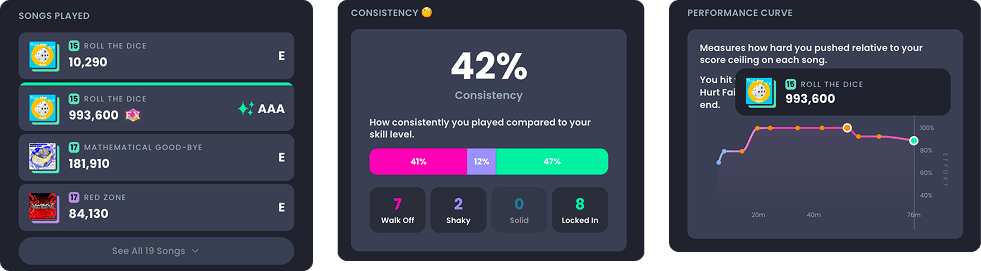
Section titled “What does Upscore actually track during a session?”Your songs and scores, session length, steps, estimated calories, and — if you have a heart-rate monitor connected — your heart rate through every song, your average and peak BPM, and the time you spent in each heart rate zone. More analytics are being added regularly too.
Here are a few examples of stats you’ll see from a session.
Is heart rate tracking free?
Section titled “Is heart rate tracking free?”Session Mode is an Upscore Pro feature. Your first three sessions are free to try.
Where do I set up my heart rate monitor?
Section titled “Where do I set up my heart rate monitor?”Two places, and they do the same thing:
- Profile → Connected devices — set it up ahead of time
- Right before a session — the pre-session screen has the same picker built in, so you can connect while you’re strapping in
Whichever you use, Upscore remembers your monitor and reconnects to it automatically next time.
On iPhone: Connected devices is also where you manage Apple Health settings.
On Android: Connected Devices is where you manage Health Connect settings.
Can I connect more than one heart rate monitor at a time?
Section titled “Can I connect more than one heart rate monitor at a time?”No. Upscore uses one heart-rate source at a time, and picking a new one disconnects the old one. This isn’t an Upscore limitation so much as a Bluetooth one: most straps and watches can only stream to one app at a time, and every fitness app we know of works the same way.
If you have both an Apple Watch and a chest strap, choose whichever you’d like to use as a heart rate monitor,
Do I pair my monitor in Upscore, or in my phone’s Bluetooth settings?
Section titled “Do I pair my monitor in Upscore, or in my phone’s Bluetooth settings?”In Upscore. Your phone’s Bluetooth settings screen usually won’t show a heart-rate strap at all, and if you did manage to pair it there it can actually stop Upscore from connecting, because the strap is then busy talking to the operating system.
If you’ve already paired it in your phone’s Bluetooth settings, remove/forget it there first, then connect it in Upscore.
My monitor isn’t in the list. Where is it?
Section titled “My monitor isn’t in the list. Where is it?”Upscore filters the scan down to things that look like heart-rate monitors, so your speaker and your neighbour’s TV don’t clutter it up. If your monitor has an unusual name it can get filtered out too. Tap Don’t see your monitor? Show all devices at the bottom of the list to see everything nearby.
Also worth checking, in this order:
- Is it awake? Most chest straps only start broadcasting once they detect a heartbeat. Put it on, wet the contacts, and give it a few seconds.
- Is it already connected to something else? A strap can only talk to one app at a time — close the manufacturer’s app (Polar Flow, Wahoo, Garmin Connect), and disconnect it from any watch or gym equipment.
- Is Bluetooth on? Upscore will tell you if it isn’t, but it’s worth a look.
- Tap rescan (the ↻ icon next to Heart Rate Source) and give it a few seconds.
It says “Not nearby” next to my monitor
Section titled “It says “Not nearby” next to my monitor”That’s your remembered monitor — Upscore keeps it pinned at the top of the list even when it can’t see it, so you don’t have to hunt for it again. It means the monitor is off, out of range, asleep, or connected to another app. Wake it up and tap rescan.
What happens if my monitor drops out mid-session?
Section titled “What happens if my monitor drops out mid-session?”The session keeps going. Upscore keeps recording your songs and scores, and the heart-rate line in your recap will just have a gap where the signal dropped. Upscore tries to reconnect on its own; if the monitor comes back, the chart picks up again.
If you take off your heart rate monitor during your session, you may need to reconnect it through the session UI for your heart rate to read again. If you remove your heart rate monitor for an extended period of time and cannot reconnect, stop your current session and start a new one.
My heart rate reads as —
Section titled “My heart rate reads as —”That means Upscore is connected but hasn’t received a beat yet. It usually resolves within a few seconds of the strap making good contact with your skin. If it stays on —:
- Wet the electrodes. Dry contacts are the number-one cause of no reading. A dab of water on the two contact strips, or just wait until you’ve worked up a sweat.
- Check the fit. Snug, directly against skin, on the sternum — below the pectorals, or right below a sports bra band. A loose strap slides and loses contact.
- Check the battery. Most chest straps take a CR2032 coin cell.
My heart rate looks wrong — spiky, or way too high
Section titled “My heart rate looks wrong — spiky, or way too high”Almost always a contact or interference problem rather than a broken monitor:
- Dry skin or a loose strap produces erratic spikes. Wet the electrodes, tighten the strap.
- Static from a loose shirt. In dry air, a fluttering shirt rubbing the strap generates static the sensor reads as beats. A snugger top or a cotton shirt fixes it.
- Wrist-based monitors are less accurate during dance. The repeated impact and wrist movement in DDR is close to a worst case for optical wrist sensors. If your numbers look implausible on a watch, a chest strap will be dramatically more consistent.
- Distance and body-blocking. Bluetooth’s 2.4 GHz signal doesn’t pass through your body well. Keep your phone in front of you (in a pocket, on the cabinet, not behind your back) and within a few feet.
Where is my heart rate data stored? Can I turn it off?
Section titled “Where is my heart rate data stored? Can I turn it off?”Upscore stores your heart-rate data on our servers so we can show you detailed session analytics, comparing your heart rate against the scores in each session. It’s never sold, never used for ads, and never shared. You can turn it off any time in Settings.
On iOS: Separately, Upscore writes your workout, steps and calories to Apple Health, which stays on your device unless you’ve turned on iCloud sync for Health.
On Android: separately, Upscore can write your workouts to Health Connect, which stays on your phone.
Does Upscore work on the web?
Section titled “Does Upscore work on the web?”Session recording and device connection are app-only. They need Bluetooth and a background connection the browser can’t give us. The web app is for browsing your scores and history.